


Pediatrics

Introductory mission and vision statement:
Since the initial development of the pediatric Rome criteria in 1999 there has been a major increase in the recognition and research related to it
Since the publication of the pediatric criteria, we have learned
a) about the pathophysiology of many of these disorders,
b) that a large number of adult DGBI start in childhood,
c) that early life events may predispose individuals to develop DGBI later in life, and
d) that pediatric DGBI are just as impactful on the quality of life and on society as many organic gastrointestinal diseases like inflammatory bowel disease.
We also now know that poorly treated pediatric DGBI can have long-term adverse outcomes, including lifetime internalizing psychiatric disorders, social phobia, and persistence of a plethora of somatic complaints, DGBI and other pain disorders.
Since their initial publication, the diagnostic criteria have been validated, the pathophysiology of the disorders is better understood, multiple randomized trials have been performed, and there are now several FDA-approved treatments for DGBI in children.
The Rome Foundation continues to invest in the development of pediatric criteria, diagnostic and treatment algorithms, relevant position papers and now, virtual education programming aimed at pediatric providers.
With the creation of the Rome Foundation Pediatric Section, we are providing the framework for additional intentional education and awareness on the prevalence of Disorders of Gut Brain Interaction in children and adolescents and expanding our reach into the field for general practitioners, pediatricians, nurse practitioners, physician assistants and particularly pediatric GI specialists to be able to recognize the disorders and provide better therapies to patients and their families.
What are our current priorities?
Rome V
The Rome V Pediatric Committees are already working diligently on updating the science and recommendations for the diagnosis and treatment of DGBI in children and adolescents and will be releasing this new information in Spring, 2026. We are very grateful to the following members of the Rome V committees for their ongoing work:
Marc A. Benninga, MD, Carlo Di Lorenzo, MD, Rachel Rosen, MD, MPH, Miguel Saps, MD, Samuel Nurko, MD, MPH, Usha Krishnan, MD, Christophe Faure, MD, Nathalie Rommel, MD, Osvaldo Borelli, MD, Alan Silverman, PhD, Michiel van Wijk, MD, Carlos Velasco, MD, Annamaria Staiano, MD, Nikhil Thapar, MD, Miranda Van Tilburg, PhD, Shaman Rajindrath MD, Katja Kovacic MD, Arine Vlieger MD, Bruno Chumpitazi, MD
Recent Publications
- Saps M, van Tilburg MA, Lavigne JV, Miranda A, Benninga MA, Taminiau JA, Di Lorenzo C.
Recommendations for pharmacological clinical trials in children with irritable bowel syndrome: the Rome foundation pediatric subcommittee on clinical trials.
Neurogastroenterol Motil. 2016 Nov;28(11):1619-1631. - Koppen IJN, Saps M, Lavigne JV, Nurko S, Taminiau JAJM, Di Lorenzo C, Benninga MA.
Recommendations for pharmacological clinical trials in children with functional constipation: The Rome foundation pediatric subcommittee on clinical trials.
Neurogastroenterol Motil. 2018 Apr;30(4):e13294. - Saps M, Lavigne JV, van Tilburg MA, Miranda A, Benninga MA, Taminiau JA, Di Lorenzo C.
Endpoints, reliability, and meaningful changes in clinical trials for children with irritable bowel syndrome. The Rome foundation pediatric subcommittee on clinical trials.
Neurogastroenterol Motil. 2018 May;30(5):e13308. - Drossman DA, Chang L, Deutsch JK, Ford AC, Halpert A, Kroenke K, Nurko S, Ruddy J, Snyder J, Sperber A.
A Review of the Evidence and Recommendations on Communication Skills and the Patient-Provider Relationship: A Rome Foundation Working Team Report.
Gastroenterology. 2021 Nov;161(5):1670-1688.e7. - Nurko S, Benninga MA, Solari T, Chumpitazi BP.
Pediatric Aspects of Nutrition Interventions for Disorders of Gut-Brain Interaction.
Am J Gastroenterol. 2022;117:995–1009. - Zia JK, Lenhart A, Yang PL, Heitkemper MM, Baker J, Keefer L, Saps M, Cuff C, Hungria G, Videlock EJ, Chang L.
Risk Factors for Abdominal Pain-Related Disorders of Gut-Brain Interaction in Adults and Children: A Systematic Review.
Gastroenterology. 2022 Oct;163(4):995-1023.e3. - Barbara G, Aziz I, Ballou S, Chang L, Ford AC, Fukudo S, Nurko S, Olano C, Saps M, Sayuk G, Siah KTH, Van Oudenhove L, Simrén M.
Rome Foundation Working Team Report on overlap in disorders of gut-brain interaction.
Nat Rev Gastroenterol Hepatol. 2025 Apr;22(4):228-251.
On Demand CE Education
Pediatric Psychogastroenterology: A Handbook for Mental Health Professionals
Miranda van Tilburg, Bonney Reed, and Simon R. Knowles:
The first consolidated resource on the topic, Pediatric Psychogastroenterology, gives mental health professionals access to the most up-to-date clinical knowledge and practice. Taking a holistic approach, it guides the reader on the treatment and care of pediatric gastrointestinal patients, as well as how to work with and support children’s parents and families. The book is structured around symptom presentation and common challenges, enabling the reader to focus quickly on the area of need. Each chapter includes clinical pearls of wisdom and 62 developmentally appropriate worksheets for patients and their families to facilitate treatment, available for download.
This practical, authoritative guide is an essential resource for mental health professionals who work directly with pediatric cohorts, as well as postgraduate students in health psychology, behavioral medicine, or social work.
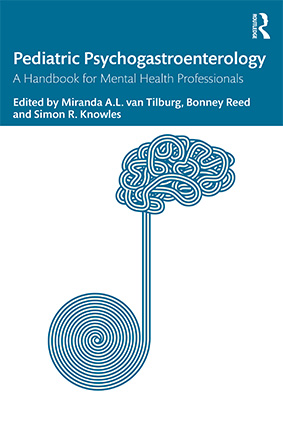
From Rome Foundation Colleagues: Miranda van Tilburg, Bonney Reed, Simon R. Knowles
Committees

Samuel Nurko, MD, MPH, RFF | Co-Chair
Professor of Pediatrics
Harvard Medical School
Center for Motility and Functional Bowel Disorders
Boston Children’s Hospital
Boston, Massachusetts, United States

Miguel Saps, MD | Co-Chair
Nationwide Children’s Hospital
Columbus, OH, USA