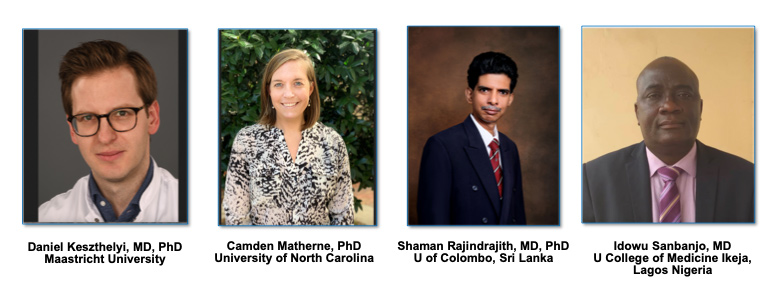


Rome Foundation Disorders of Gut-Brain Interaction International Research Awards
Description
Objective
Eligibility
- Award recipients will be selected based on the novelty, importance, feasibility, environment and the overall likelihood that the project will lead to subsequent, more substantial grants in the areas of DGBI research.
- Candidates for these awards must hold an MD, PhD, PsyD or equivalent degree and be at least 30% time at an accredited institution in a clinical or research role. The institution need not be an academic medical center.
- Candidates for the $10,000 award will preferentially apply from geographical areas where DGBI research is not well established and funding opportunities are limited.
- Women and minorities are strongly encouraged to apply.
- Rome Foundation board members are ineligible, and applicants cannot have active research collaboration with Rome Foundation board members.
Requirements
- The proposed research proposal must address the pathophysiology, epidemiology, diagnosis or treatment of DGBI or any combination.
- The awards are allocated to clinical and translational research. Consideration is given to proposals that have the potential to influence clinical management.
- Allowable Costs:
- Applicant’s salary and benefits
- Research assistants and/or laboratory technicians
- Biostatistics support
- Supplies and/or equipment
- The following costs are not allowed:
- Preceptor’s salary and benefits
- Travel costs
- Indirect costs
- A letter of recommendation from the Division Chief or Department Chair or from an established Senior Investigator is required for all applicants.
- Established investigators who are applying for this award should state explicitly how the research being proposed is different from their previous line of research.
- Upon receipt of this award, the recipient must provide notification or a waiver of approval from the appropriate institutional committee for the use of human subjects or animals. If approval is not necessary, the recipient must provide an explanation.
- A scientific and financial progress report must be submitted to RF by the award recipient one year and any subsequent year from receiving the award while the study is in progress.
- A final report must be submitted upon completion of the project.
- Investigators are allowed to apply for both the $40,000 and $10,000 research awards.
- That applicant must specify if they hold additional funding or intend to apply for additional funding for the same project.
- Projects using data from the Rome Global Epidemiology Study are also eligible for funding.
Review Process
A selection committee comprised of seven members of the Rome Foundation Research Committee will review the proposals and select the award recipients. Awardees will be notified by April 1, 2027. Funding will commence on June 1, 2027.
*Non-selected applicants will be notified after April 1, 2027, via email. Personalized feedback is not possible due to the high number of applicants.
Application Process
- The application opens on September 18, 2026, and closes on January 31, 2027, with no applications accepted after midnight EST.
- Applications must be submitted through the RF website. No Exceptions.
- Applicants may only submit one application for this award per calendar year.
- The project proposal is limited to four pages.
- The proposal should contain the following headings:
- Background / State of the art
- Preliminary results (if applicable)
- Work plan
- Clinical significance
- Research environment
- The application must also contain:
- Two-page CV.
- One-page budget,
- Letter of support from Division Chief or Department Chair, or from an established Senior Investigator.
- Award ceremonies will be held at DDW 2027.
- Please submit your application by completing the form on this web page beginning September 18, 2026. Applications will not be accepted via email, fax, or hard copy.
- Please direct all questions to the RF Award Program to Mauricio Rojas at mr****@***************on.org.
Support for this award is provided by the Rome Foundation.
Please note: It is the general policy of the Rome Foundation to pay only direct costs, not institutional overhead (indirect costs), on research grants and contracts awarded.
Rome Foundation Research Award Winners 2026

Andrea Sepulveda, MD, Associate Instructor-Pediatric Division, Pontifical Catholic University of Chile. Santiago, Chile
Characteristics of Rome IV Non-Erosive Esophageal Phenotypes in Children: Aprospective Observational Study

Giada de Palma, PhD, Assistant Professor at McMaster University. Hamilton, Canada
Investigating microbiome-host interactions underlying tricyclic antidepressant efficacy in irritable bowel syndrome visceral pain

Palittiya Sintisek, MD, PhD, Associate Professor, Head of Division of Gastroenterology, King Chulalongkorn Memorial Hospital. Bangcock, Thailand
Development of a Culturally Adapted Internet-Based Cognitive Behavioral Therapy Program for Children with Functional Chronic Abdominal Pain Disorders and Their Families
Associate Professor Palittiya Sintusek, MD, PhD, is the Head of the Division of Gastroenterology in the Department of Pediatrics at King Chulalongkorn Memorial Hospital, Chulalongkorn University. She also serves as the Director of the Center of Excellence in Thai Pediatric Gastroenterology, Hepatology, and Immunology (TPGHAI), Chulalongkorn University, Thailand.
She holds a PhD in Clinical Sciences from Chulalongkorn University and an MSc in Paediatrics and Child Health (Pediatric Gastroenterology) from University College London (UCL), United Kingdom. Her international training includes the Bill Marshall Fellowship at Great Ormond Street Hospital and a Research Fellowship at the Dubowitz Neuromuscular Unit, UCL.
Dr. Sintusek is an accomplished researcher with approximately 60 peer-reviewed publications, an H-index of 13, and nearly 700 citations. Her work has been recognized with several prestigious awards, including the ESPGHAN Young Investigator Award (2015, 2016, and 2019), the WCPGHAN Young Investigator Award (2016), and the Best Abstract Award in Hepatology at WCPGHAN 2020.
A significant highlight of her recent research includes leading the validation and reliability study of the Thai “Rome IV diagnostic questionnaires” for functional gastrointestinal disorders in neonates and toddlers, a project authorized by the Rome Foundation.
Following this validation, she conducted extensive research on the prevalence of functional gastrointestinal disorders in Thailand using these standardized instruments to improve diagnostic accuracy and epidemiological understanding in the Thai pediatric population.
In addition to her research and clinical work, she serves as an Assistant Editor for BMC Gastroenterology and Baishideng Publishing Group. She is also an active member of several international professional societies, including APPSPGHAN (serving on the Gut-Brain, Neurogastroenterology, and Motility Subcommittee), AASLD, ESPGHAN, and ESNM.

Rebecca Liu, MD, PhD. Boston, Massachusetts
Defining Autonomic Dysfunction and Central Sensitization Phenotypes in Functional Dyspepsia.
Rome Foundation Research Award Winners 2025

Caroline Tuck, PhD – Rome Foundation Diet & Nutrition, Chair, Senior Lecturer, Doctor of Philosophy, Monash University, Australia
Targeting pain with diet in irritable bowel syndrome: the PART with Pain study

Carmen Alonso-Cotoner, MD – Hospital Vall d’Hebron (HVH), Gastroenterology Department. Barcelona. Spain
When disaster hits the gut: effects of the massive 2024 flooding of Valencia on the prevalence and severity of IBS and functional dyspepsia.

Jonathan Kuang Ziyang, MBBS, MRCP (UK) – Tan Tock Seng Hospital, Singapore
The Use of an Artificial Intelligence Journaling App in Patients with Irritable Bowel Syndrome – A Pilot Study

Sarantuya Gidaagaya MD, Ph.D. – Mongolian National University of Medical Sciences, Mongolia
Adapting and applying the Rome IV Criteria to evaluate disorders of Gut-Brain interaction among Mongolian adults
Rome Foundation Research Award Winners 2024

Jessica Biesiekierski, PhD Monash University, Melbourne, AU
A randomized controlled trial of internet-based low FODMAP diet versus exposure-based cognitive behavioral therapy

Grace Burns, PhD University of Newcastle, AU
Understanding small intestinal Eosinophil Accumulation to manage better and treat disorders of gut-brain interaction (DGBI).

Justin Lee, MD, Hospital Universiti Sains, Malaysi
Development and validation of GI symptoms animated pictograms (GAP) to improve symptom communication in patients with neurodegenerative diseases.

Cristian Garay, PhD Universidad de Buenos Aires
Rome Foundation Research Award Winners 2023
Awarded for Original Global Research in Disorders of Gut-Brain Interaction

Yasmin Nasser, Calgary, Canada
Mind Body Interventions: Does an integrated yoga intervention modulate gut microbial dysbiosis in IBS?

Imran Aziz, Sheffield, UK
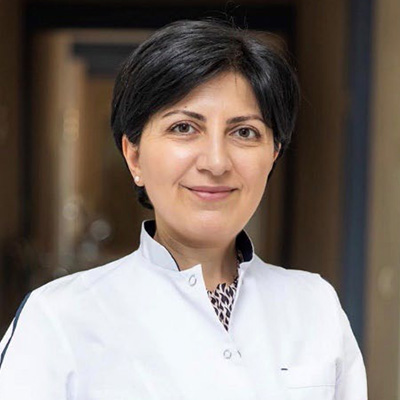
Manik Gemilyan, Yerevan, Armenia
Identifying and tackling barriers to effective diagnosis and management of disorders of gut-brain interaction in Armenia
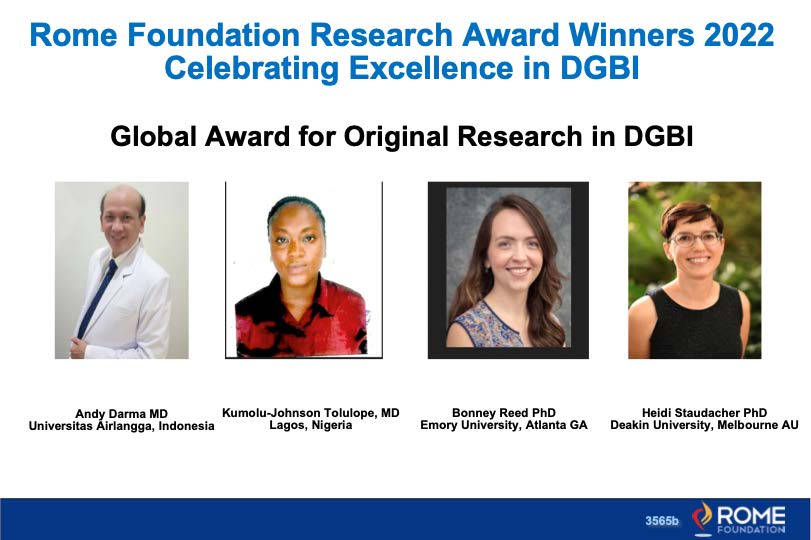
Rome Foundation Research Award Winners 2022
Awarded for Original Global Research in Disorders of Gut-Brain Interaction
Rome Foundation Research Award Winners 2021
Awarded for Original Global Research in Disorders of Gut-Brain Interaction